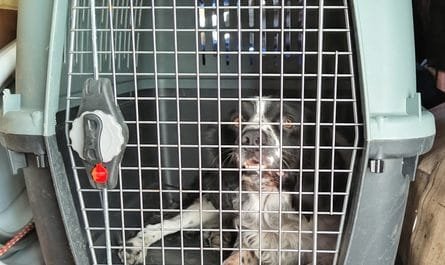

 by
by Last Updated on 02/10/2026 by Claire Coney
Travelling with dogs is wonderful, but choosing the right dog crate for travel can feel like solving a puzzle with four very opinionated pieces.
Over the years, our pack has taught us that every dog has different needs — from the pups who wanted to share a crate, to the adults who insisted on their own personal space.
Finding the right travel crate isn’t just about size or style; it’s about comfort, safety, and understanding how your dog likes to travel.
In this post, I’ll share what we’ve learned on the road and help you choose the best dog crate for travel so your adventures are calmer, safer, and a lot more enjoyable.

If you’d like a simple, ready‑to‑use guide that covers everything you’ll need for the journey (from safety gear to comfort items), you can grab my free Dog Travel Checklist below. It’s the same one I use when packing for Ellie, Charlie, Archie and Murphy, and it keeps the whole trip running smoothly.
Readers like you support The Fido Trail! If you shop through our links, I might earn a little commission, which helps me create more adventures for Charlie, Ellie, Murphy and Archie and share dog-friendly travel tips. Don’t worry—you won’t pay more. Thanks for your support!
Why a Travel Crate Matters
Travel crates are not just about convenience—they’re about safety:
- Prevent distractions while driving.
- Meet airline and train carrier requirements.
- Provide a secure and familiar space for your dog.
- Help reduce travel-related anxiety.
Choosing The Right Size Travel Crate
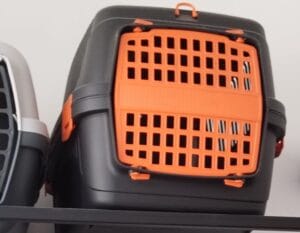
Choosing the best crate size for your dog is crucial. You want to make sure your furry friend has enough room to stand up, turn around, and lie down comfortably in the crate. But you also don’t want to give Fido too much space, as this can make him feel insecure or tempt him to use the crate as a bathroom. A crate that is too small can also harm Fido’s well-being, as it can cause pain, injury, or stress.
Measuring Your Dog for a Travel Crate
To find the right crate size for your dog, you can follow these steps:
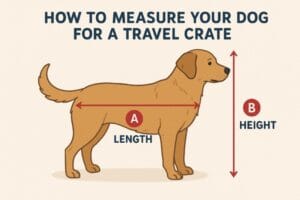
Step 1: Measure Your Adult Dog
Before you buy a travel crate, measure Fido’s height, length, and width with a tape measure or ruler. Fido’s height is measured from the floor to the top of his head or ears. His length is the distance from his nose to the base of his tail. His width is measured across his chest or shoulders.
Measuring Your Puppy for a Travel Crate
If Fido is a puppy and still growing, choose a crate that will accommodate his adult size—not just his current size. Estimating your pup’s future growth can help avoid buying multiple crates as he matures. Start by identifying your puppy’s breed or breed mix and his current age.
This information will give you a general idea of his anticipated adult weight and height. You can use a growth chart or calculator online to predict how big he might get at full maturity.
Alternatively, consult your veterinarian for a more accurate estimate based on your puppy’s age, breed, and current weight.
🐾 Pro Tip For Measuring Puppies: Here’s the formula that my vet gave me to estimate my puppy’s adult weight (for medium to large breeds):
Adult weight = (Puppy weight at 4 months) × 2.5
When buying a travel crate, choose one that fits your puppy’s projected adult size. If you’re investing in a larger crate now, look for models that come with adjustable divider panels. These allow you to resize the interior space as your puppy grows, providing him with a snug and secure area without the need for frequent upgrades.
🐾 Pro Tip for DIY crate dividers: If you’re using a larger travel crate for your puppy, I recommend making a simple DIY crate divider to adjust the space as they grow. I made mine using an old shoe rack, but you can also use plywood, a thick cutting board, or sturdy cardboard for temporary use. First, cut the divider to fit inside the crate. Then secure it with zip ties or bungee cords through holes in the corners. It really helped with potty training and kept my puppies from feeling overwhelmed by too much space. Plus, it saved me from buying multiple crates as they got bigger!
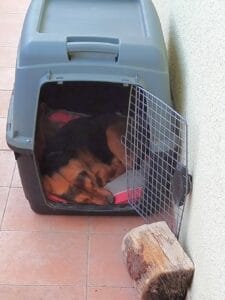
Step 2: Compare Your Dog’s Measurements To The Travel Crate Dimensions.
You can find the dimensions of the travel crate in the product description or on the label.
Alternatively, refer to a crate size chart for your dog’s breed and weight. Ideally, the travel crate should be 2 to 4 inches longer and taller than your dog and slightly wider as well.

If possible, try out the crate before making a purchase. Bring your dog to the store and let them enter the crate. They should be able to stand up, turn around, and lie down comfortably. If not, consider selecting a different size.
Training Your Dog To Love Their Travel Crate
Training a dog to travel in a crate really comes down to helping them see it as a safe, comfortable little den.
I always start at home, letting the dogs explore the crate in their own time — no forcing, just treats, toys, and plenty of praise. Here is my guide to crate training your dog. Here’s my guide to training your dog to be your travel companion.
With the pups, crate training began early. Charlie and Archie took to car travel like naturals, while Murphy… well, Murphy needed a bit more patience (and a lot of ginger biscuits).
Abigail and Ellie, both rescues, were adults when I introduced crates to them, so we took things slowly. With consistency and calm encouragement, each of them learned that their crate wasn’t something to fear — it was their own cosy space for travelling. Here is my guide to crate training your dog.
Our Real‑Life Travel Crate Experiences
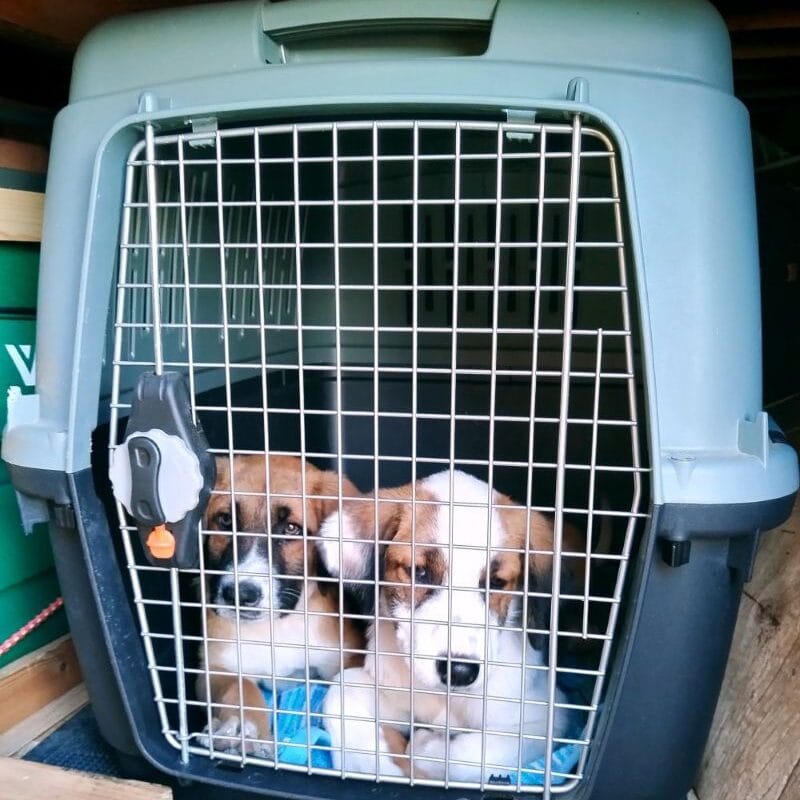
Our pack has taught us more about travel crates than any guide ever could. When Archie and Murphy were pups, they insisted on sharing a crate, curled up like two socks that refused to be separated. As they grew (and grew…), they needed their own space. Ellie, being a rescue, preferred a quiet corner where she could settle without fuss, while Charlie liked a crate with enough room to stretch out and supervise the whole van. Each dog’s needs changed over time, and learning to adapt their crates to their personalities made every trip calmer and far more enjoyable.
Size and Breed Compatibility
Some Travel crates work better for certain dog sizes. I have provided a quick guide to help you:
| Dog Size | Crate Size | Recommended Crate |
| Small (Chihuahua) | 19–22” | Ferplast Atlas Mini Car Dog Crate |
| Medium (Cocker Spaniel) | 28–30” | Ferplast Atlas Scenic Car Transport Box |
| Large (Labrador) | 36–42” | Trixie Light Grey/Dark Grey Transport Box Gulliver |
| Extra Large (Greman Shepard) | 48”+ | AluRide Dog Crate for Extra Large Dogs |
The Difference Between A Dog Travel Crate And A Carrier!
The primary difference between a dog travel crate and a carrier lies in their size and construction. Travel crates are generally more robust and larger. Carriers, on the other hand, are typically smaller. They are soft-sided and designed for carrying smaller dogs. It’s important to choose the right type based on the size of the dog and the mode of transport.
Brands of Travel Dog Crates
There are many brands of travel crates available on the market, but not all of them are equally reliable or suitable for your dog. Some of the most popular and trusted brands are Trixie, Aluline, Feria and Ferplas. You can read customer reviews, compare prices, and check the features of each brand before making a purchase. Here is my guide to dog travel crates for a stress-free trip.
Material Types for Dog Travel Crates
The material of the travel crate affects its durability, weight, and comfort. Here are the most common types:
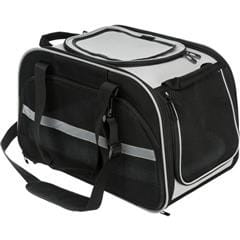
Fabric Soft-Sided Travel Crates
Fabric travel crates are lightweight, cosy, and portable. They are great for small dogs and short trips. Lightweight and easy to store. However, they are not suitable for dogs who like to chew or scratch.
Plastic (Hard-Sided) Travel Crates
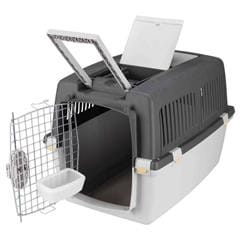
Plastic travel crates have been a great option for us — sturdy, easy to clean, and surprisingly cosy.
Charlie uses one, and it’s become his little portable bedroom. I can lift it in and out of the campervan without a fuss, set it up at campsites or Airbnbs, and he settles straight in. For a dog who likes his own comfy corner, it’s ideal.
Metal Wire Travel Crates
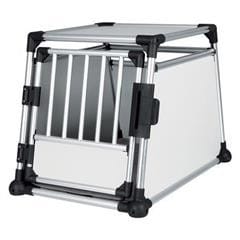
Metal travel crates are durable, ventilated, and allow you to see Fido. Suitable for crate-trained dogs during car travel, not for flying.
- Best Pick: Trixie Aluminium Dog Crate
Dog’s Travel Crate Shapes
Different travel plans require different crate shapes. Some crates can fold or collapse to save space and make them easier to carry.
Dog Crates For Air Travel
You will need a crate that meets the airline’s requirements and fits under the seat or in the cargo area. Look for IATA-compliant crates (airline-approved). Hard-sided crates with secure latches are a must. Check your airline’s pet travel policy.
Dog Crates For Car Travel
You will need a crate that fits in your vehicle and does not obstruct your view or interfere with your driving.
Dog Carries For Train or Bus
Soft-sided carriers may be required, so it’s important to check each company’s pet policy. I particularly like using a rucksack for my Cairn Terrier, Abigail. It’s easy to pop her inside, leaving my hands free to carry my own luggage. It’s also great for hiking! Kurgo Rucksack is ideal for small dogs.

Dog Travel Crate Ventilation
Ventilation on multiple sides. The crate should have enough ventilation holes or mesh panels to allow air circulation and prevent overheating. This is especially important for hot climates or long trips. Ventilation also helps your dog see outside and feel less anxious. For example, Ellie tends to worry and cry when she can’t see us.
Should Dogs Share Travel Crates?
I wouldn’t recommend having dogs share a travel crate on long journeys. Sharing a crate can cause anxiety, aggression, overheating, and injury for dogs, especially if they are not used to being confined together.
Moreover, some airlines and other transport services have strict regulations that prohibit dogs from sharing a crate. However, there are exceptions when my two Greek rescue puppies, Murphy and Archie, came along; they were scared and dependent on each other, so I decided to crate them together. They are much happier when travelling in our van together.

Safety Requirements for Dog Travel Crates
The travel crate should have a secure latch or zipper that prevents Fido from escaping or getting injured. It should also have smooth edges and corners that do not pose a choking or cutting hazard.
Removable pads or cushions. Carrying handles or wheels for portability. Ensure your dog’s travel crate is secure and stable. If you are travelling by car with your dog, the crate should be strapped in to prevent it from moving during the journey. Avoid placing the crate near sharp or hot objects or in direct sunlight.
Additionally, you should check the crate for any signs of damage or wear before each use. No matter what carrier you choose, it should be easy to assemble, store, and use. Otherwise, you will be less likely to use it.
Travel Crate Accessories
A few simple accessories can make a travel crate feel much more comfortable for your dog. I always add a familiar blanket or bed so the crate smells like home, and a favourite toy for a bit of reassurance on longer journeys. In summer, I use clip‑on fans or cooling mats to keep everyone comfortable, and for winter trips a cosy fleece works wonders. These little extras help turn the crate into a safe, familiar space — whether we’re on the road, parked up in the campervan, or settling into an Airbnb for the night.
🐾 Pro Tips For Making Your Dog’s Create Cosy: Check out my guide to travel crate accessories!
Travel Tips for Road Trips & Campervans
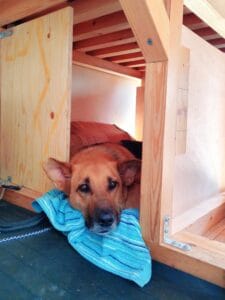
Travelling with dogs in a campervan is its own kind of adventure, so a good travel crate becomes part of the rhythm of the trip. I always make sure each crate has a familiar blanket or toy, and I secure them so they don’t shift on winding roads. Ventilation is key, especially in summer, and I keep water close by for quick stops. Most importantly, I give the dogs time to settle before we set off — a calm start makes the whole journey smoother. With the right setup, crates become cosy little dens that help your dogs feel safe wherever you park for the night.

Wrapping It Up
You have learnt a lot about how to choose and use a travel crate for your dog. Here are some main points to remember:
- A travel crate is more than just a container for your dog. It’s a place where they can feel safe, comfortable, and relaxed.
- The size, shape, material, and travel crate design should match your dog’s needs and preferences.
- Measure your dog and compare it to the crate dimensions before buying one.
- Consider your dog’s personality, age, health, and travel habits when choosing a travel crate. Some dogs may need more ventilation, padding, visibility, or security than others.
- Make your dog’s travel crate a cosy and fun place. Add water, toys, treats, and familiar items. Do not forget to check on your dog regularly and offer them water.
- Always make sure your dog’s travel crate is secure and stable. Avoid placing it near sharp or hot objects or in direct sunlight.
With these tips, you can find the perfect travel crate for your dog and have a great time together on your next adventure.
Now you are all set to browse my travel guide:
And don’t forget to get your free checklist before your next trip!